
By Jennifer Fairfield
If you were hoping that our lovely little heat wave was a thing of the past, I hate to break it to you, but the forecast for the rest of the summer is much of the same – higher than normal temperatures and rainfall. That should make keeping up with outdoor chores a real chore. Maybe I should take up an indoor activity. Any good suggestions?
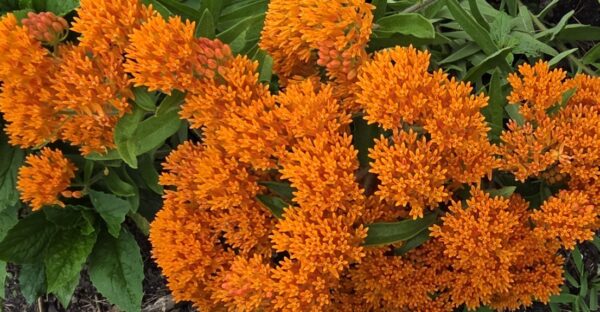
July is a great month for gardening, if you can stand the heat, of course. In the vegetable garden, some things are finishing up their production, like peas and spinach, while others are just starting to be harvested this month. I can’t wait to harvest some of the millions (only a slight exaggeration) of cucumbers on my plants right now. In my flower beds, my purple coneflowers and bee balm are just starting to put out blooms, and my butterfly weed is calling out to all the butterflies in the area. All this is great for the soul.
While all this beauty is great, it doesn’t all take care of itself. There’s lots to do this month in the garden.
In the vegetable garden:
While extreme heat may be a bit too much for us, at least there are things most of us can do to cool down a little – get indoors into air conditioning, get ourselves a big glass of something cold to drink, or even just seek out some shade. Plants can’t do any of that, which means that they are at the mercy of the heat. All that heat can take a toll on plants, and you’ll see it in a variety of ways.
Tomato plants will curl their leaves, lettuce will bolt, tomatoes and peppers may drop their flowers, and many plants may show signs of sun scald. There are some things you can do to help your plants get through the extreme heat periods, including providing shade, watering more frequently, making sure plants are properly mulched, and more. Oregon State University’s Extension Service has lots of advice for dealing with the heat.
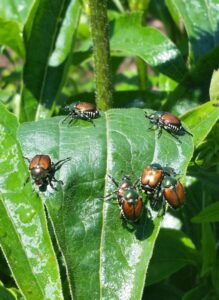
July is insect pest time. Actually, they’ve already gotten started. I have had multiple conversations with people about damage they are seeing on their plants over the last couple of weeks. The biggest culprit so far this year seems to be fourlined bugs, but we’re also seeing Japanese beetles, cabbage moth and diamondback moth caterpillars, aphids, slugs, and flea beetles (just to name a few).
What to do about them all? Unfortunately, there isn’t a one-size-fits all solution, and it’s important to know what’s eating your plants, to be sure that you are using the proper controls. So, let’s tackle them one-by-one (and if there’s something eating your plants that I’m not covering here, please feel free to call or stop in):
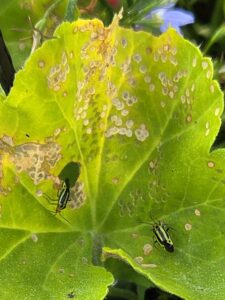
The damage caused by the yellow-green and black-striped fourlined bugs can look a lot like a disease, but it’s actually the result of the bugs piercing the leaves of your plants and sucking the chlorophyl out, leaving behind small, dark circles. Over time, the tissue in those circles will die back and you are left with holes.
You can tell the difference between damage from fourlined bugs and the spots that appear from leaf spot diseases by the fact that the circles from the insects are generally uniform in size and shape, where disease spots can differ in both size and shape. Most of the damage done by fourlined bugs isn’t enough to harm plants, so you don’t necessarily need to treat for them, but they can cause significant damage to younger plants as well as to some herbs and vegetables – basil and peppers are among their favorites – and if they congregate on your plants in larger numbers, they can cause leaf death and limit the plant’s ability to synthesize chlorophyl. Neem Oil is the best option for organic control of these bugs.
Cabbage moth and diamondback moth larva can easily be picked off of your plants and squashed. Finding the cabbage moth caterpillars can be difficult, though. Look for them on the undersides of the leaves (though they may also be on the tops), and look really closely – they are experts at camouflage and their green color almost perfectly matches the green of their favorite plants.
Even if you find one or two, there may be more that you miss, so check back again in a day or two. One clue to where to find them is to look for their excrement. If you see fresh green-black pellets on the leaves, the caterpillars are likely nearby. If you don’t like the idea of touching or squishing them, products containing Bt are the best option for organic control. Be sure to do something to control them, though – they can decimate your crops quickly if left to their own devices.
Aphids generally hang out in large groups at the tips of stems (they like succulent, new growth best) and on the undersides of leaves. Aphids come in lots of colors, including green, black, yellow, orange, red, and white. A good squirt or two of insecticidal soap is all it takes to neutralize these pests, but you need to spray them directly for it to be effective. So, find them, and then spray them. Aphids reproduce at an amazing rate, so get them early and often. Neem oil can also be very effective in controlling aphids.
Slugs are one of my least favorite creatures in the garden. They’re gross (and I’m not easily grossed out), and they’re sneaky. They mostly feed at night, because they dry out too easily in the sun. So, if you are seeing lots of damage to your plants that seems to show up overnight, and you can’t find any insects, you probably have slugs. If you look under your mulch, you might find them hiding there (they also really like lettuce, and you can often find them within the leaves). These guys, because they stay hidden most of the time, can be hard to control.
Diatomaceous earth, which can be sprinkled around the plants, is one option. It is scratchy and will shred the soft bodies of the slugs as they try to get to your plants. You can also use window screening, cut into circles, and placed at the base of your plants. Slugs generally avoid anything scratchy, so will stay away from screening. A bait and poison product is also an option. These are generally in a pellet form that is easy to shake around your plants.
Flea beetles and Mexican bean beetles are a little more difficult to deal with, because they are escape artists. Flea beetles are tiny, black beetles that eat tiny holes in the leaves of your plants – it looks like somebody shot your plants with a bb gun. They eat a number of different plants and are hard to spot.
Mexican bean beetles pretty much just stick to eating bean plants. They are the size of ladybugs, and look a lot like ladybugs, but are generally yellow to orange in color, and always have exactly 16 black spots on their wings– 8 on each wing. Ladybugs, on the other hand, come in a variety of colors, but generally have fewer spots.
Both flea beetles and Mexican bean beetles jump really far, really fast, when they are threatened, so trying to spray them can be difficult. However, diatomaceous earth can be effective against these critters. Controlling both of these creatures is important – flea beetles can spread diseases to your plants, and Mexican bean beetles can decimate bean crops in short order. Sprays containing Spinosad have also been shown to work to control these pests.
Weeds are another big problem in gardens at this time of year, and all the heat and rain we’ve been getting this year is good for them. While keeping up with them can be a real chore, the best thing to do is to try to get them while they’re small, mostly because they are easier to pull out before their roots are too established.
Since weeds compete for water and nutrition with the plants you want, don’t let them get out of control. At this time of year, crabgrass, spurge, thistle, and black medic tend to be some of the most common problems. Of these, thistle is the hardest to get rid of and the most invasive, though there are certainly others that make the life of the average gardener difficult.
Rounding out the trifecta of garden problems to work to keep under control this month (and really, for the rest of the season) is disease. Diseases can get out of control if you don’t keep up with a regular program of fungicide spraying. There are a lot of diseases that really get going as summer progresses, especially on tomatoes, cucumbers, and squash. The MSU Extension Service has already identified Downy Mildew in four counties in Michigan, including Monroe and Lenawee, so you know it’s going to show up here any day now.
Treating your plants with an organic fungicide on a regular basis can help keep them from succumbing to disease, which means that you might actually get to eat a lot of what you planted. If you’re not sure how to tell what’s ailing your plants, Cornell University offers lots of information on their Disease Fact Sheets and Articles page. But don’t wait until you see disease to treat it – most diseases can’t really be treated, only prevented. Start treating your plants now, if you haven’t already.
July should be harvest time for many crops. Spring crops, such as lettuce, spinach, and peas are generally done producing by early this month, while summer crops, such as zucchini, cucumbers, and early tomatoes will just be getting started by the end of the month. Producing all that great stuff is a lot of work for your plants, so make sure to give them some fertilizer this month. Side dressing, so-called because you are putting fertilizer in the soil alongside your already growing plants, provides plants with a little extra food when they need it most – as they are doing the most growing and as they are producing flowers and fruit.
By the time they are ready to start putting out flowers, the plants have used up most of the available nutrition in your garden. Providing a little more fertilizer at this point will make a big difference in whether your garden produces in abundance, which is the point of all this work, isn’t it?
When applying fertilizer at this time of year, carefully work it into the top inch or so of soil so as not to disturb roots. Don’t get any closer than about four inches from the stem of the plant, as you want the food to be available to the new root growth as the plant is growing and putting out more roots.
Garlic is generally ready for harvest between mid-July and early August, depending on the variety and when it was planted (fall vs. spring). If possible, stop watering your garlic about three weeks before you expect to be harvesting (I say “if possible” because my garlic is in the same bed as other plants, and I don’t want to deprive those plants of water, which makes it hard to stop watering the garlic, but it hasn’t really caused me any problems with my garlic).
You can tell that it’s ready to be harvested by the foliage. When about one-third of the leaves have yellowed and withered, it’s time to check on your bulbs. Gently wipe some of the soil away from a bulb and check the size and form of your garlic. If it looks like a good size, it’s ready to come out. If not, leave it for another few days to a week, and check again. Don’t leave garlic in the ground too long past peak harvest time though, as this could lead to rotting.
July is also a time for planting and starting new seedlings for fall harvest. If you want to have broccoli and cabbage for fall, start your own inside by no later than July 10th, and transplant the seedlings into your garden when they are four to six weeks old. They should be ready for harvest by early October. These can be good “succession crops” to be put into the garden in place of things like onions and garlic, once those have been harvested.
You can plant late season successions of lettuce, spinach, peas, beets, carrots, and Swiss chard at the end of the month, to be ready for picking before it gets too cold. Wait to plant radishes until early or mid-August, as it will generally still be too hot at this point for these cool-weather lovers (they mature very quickly, and will bolt in the heat of August before they can get big enough for eating).
Don’t forget to monitor how much water your garden is getting from Mother Nature, and be prepared to supplement it. Your plants generally need about an inch of water every week, but when the temps are really high, and especially when accompanied by wind, a little more water is even better.
A good soaking once or twice a week is better than a little bit every day. Don’t overdo it, but definitely make sure that your soil doesn’t totally dry out between watering. That’s a great way to stress your plants.
(Publisher’s note: Part 2 will publish tomorrow.)