
By Lisa Carolin
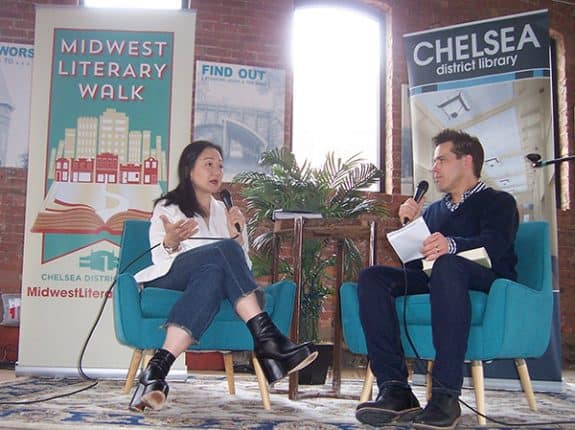
Chelsea District Library’s annual Midwest Literary Walk on Saturday, April 27, drew hundreds of people to the area to see author Min Jin Lee at the Main Street Church, poet and children’s book author Luis J. Rodriguez at the Chelsea Depot, and journalist and debut novelist Anissa Gray at Chelsea First Congregational Church.
At 1 p.m., Susan Lackey, president of the Chelsea District Library’s board, greeted the crowd at the Main Street Church saying, “For the very first time, we’ve run out of seats, and that’s very cool. For a community the size of Chelsea to do this for 11 years is pretty phenomenal.”
Close to 200 people came to see Lee speak with moderator Rich Fahle, executive producer of PBS Books, as well as to buy copies of her books sold by Ann Arbor’s Literati Books and to get autographs from the author.
Lee, who was born in Seoul, South Korea and came to the U.S. at age 7 with her family, began her career as a history major and then became a lawyer. It was actually in 1989 at the age of 19 during a lecture by a missionary at Yale University that she was inspired by the topic of Koreans who lived in Japan. The speaker talked about a Korean boy who jumped off a building to his death after growing up in Japan and receiving hateful comments from his middle school classmates.
“That story burned into my brain,” said Lee. “It didn’t fit with my understanding of the world.”
Lee had suffered from a liver disease when she was young and was told by her doctor that she would get liver cancer by the time she reached her 20s or 30s.
“I didn’t know how much time I had,” the 50 year old told the audience, adding that as a lawyer she worked-in humane hours. “I decided I couldn’t do it anymore and thought I would write a novel. It took me 12 years to write that first novel.” (Free Food for Millionaires)
When her husband got a job in Japan in 2007, the family moved there. Lee wanted to understand the history of Koreans living in Japan and interviewed many Koreans, whom she felt connected to.
Her second book, Pachinko, tells the story of a Korean family living in Japan from 1910-1989.
“It’s a multigenerational saga of Koreans being outsiders in Japan,” she said. “Imagine if you couldn’t tell your friends that you were ethnically Korean. Every one of my interviewees talked about passing for Japanese.”
Pachinko, Lee explained, is a 203-billion-dollar industry in Japan. It’s a vertical pinball game that invites people to gamble and got popular after WWII. She said that Koreans couldn’t get good jobs in Japan because they were considered untrustworthy, but Korean men were able to get jobs in the Pachinko business while Korean women could only get jobs in food service.
She shared that Apple picked up the rights to turn Pachinko into a television series. Lee also read a compelling segment from the book.
When it came time for questions from the audience, Lee was asked how the book has been received by Korean and Japanese people. She said it’s been very well received by Koreans, but won’t be translated into Japanese until this fall.
She was asked if one of the main characters in Pachinko is a feminist, and Lee responded, “She’s unequivocally a feminist.”
When asked what her writing process looks like, Lee responded, “I write all the time, and I’m interrupted all the time. I was a working mom while writing these books. The only thing the writer can control is the quality of her work. You do it because you love it and because you believe in your message. I believe unequivocally in my message.”
Lee said that she has practiced something she learned from author Willa Cather.
“I read a chapter of the Bible before I work,” Lee said. “It’s been incredibly helpful to me.”
Lee is working on what she calls a “diaspora trilogy” called The Koreans with the hope of better understanding immigration and the diaspora.
“I’m focusing on Koreans because they’re a group who have been understudied,” she said. “I’m hoping that I can make a difference.”