
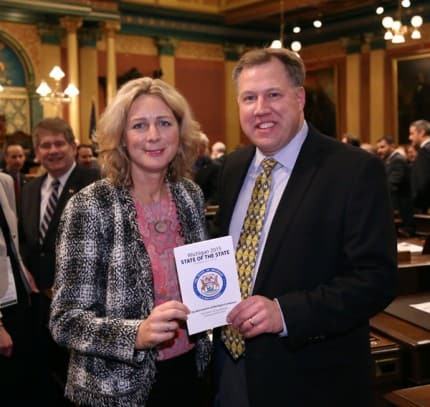
State Representative Gretchen Driskell (D-Saline) attended Gov. Rick Snyder’s State of the State address on Tuesday, Jan. 20, at the state Capitol. Joining her is Dexter Mayor Shawn Keough.
In response to Gov. Rick Snyder’s State of the State Address Tuesday night, State Rep. Gretchen Driskell, (D-Saline) said that the Legislature needs to focus on making Michigan’s economy work for the people of Michigan.
She said Snyder only briefly mentioned the looming deficit Tuesday night, which she says in a press release, is caused by a massive tax shift away from big corporations. This raises concerns that the administration will suggest reducing services for Michigan’s most vulnerable citizens, she said.
“The merger of the Department of Human Services with the Department of Community Health, along with recent eliminations of hundreds of DHS employees, validates those concerns,” Driskell said.
“While our governor suggests this will streamline services, I need to see details that support this,” she said. “We now see the direct result of the governor’s discriminatory tax shift – an impending multi-million-dollar deficit that only grows larger over the next fiscal year. The huge tax shift away from wealthy corporations and onto the backs of working families has resulted in real dollars being lost that could have gone into our communities and our schools, helping to improve the standard of living for everyone, not just the administration’s favorite corporations.”
She said Snyder also expressed his support for the proposal to raise money for road improvements, which comes in the form of a sales tax increase that must be approved by voters on the ballot in May. Driskell and members from both parties backed the plan last term, but only after it included restoring the Earned Income Tax Credit to its former level and increasing funding for schools and communities.
“I was proud to work with colleagues from both sides of the aisle to reach a deal that finally allowed us to move forward with investing in our crumbling infrastructure,” Driskell said. “By ensuring we have adequate roads to travel on, coupled with more resources for schools and public transit, we make sure everyone benefits and our roads are safe.”
Driskell reiterated her priorities for Michigan on several issues. Funding in the classroom is still down after it was significantly cut in 2011, and legislation to better regulate for-profit charter schools was left to wither in committee. House Republicans caved to special interest demands on women’s health care, making it harder for Michigan’s women to access the health services they need.
She said rather than continuing the failed approach of massive handouts to wealthy corporations, she wants to increase support for entrepreneurs and the small businesses that truly drive our economy.
“After so many years of the same failed policies, we need to look for real solutions, like growing our revenue base,” Diskell said. “We can do that by making Michigan an attractive place to live with great schools, community services, and a healthy environment. We can’t continue cutting away and expect the state to grow.”