
By Crystal Hayduk
The Chelsea School District Board of Education approved the 2014-15 amended budget at Monday evening’s meeting, following a presentation by Teresa Zigman, executive director of business and operations. The three resolutions involved the general fund, including athletics; special revenues, including food service and community education; and debt service funds.
In the general fund, Zigman said that the district originally expected to use $578,000 of fund balance.
“After a lot of individual line analysis all the way through, we’re still looking at using about $551,000,” she said. Within the revenue and expenditures, there were huge swings of over $1 million each. Among the line items that make up the swings, the largest is for MPSERS (retirement). The state gives funding to the district, but receives it back five days later. “On their end, they’re able to say they’ve funded schools – and they have – but then in essence we’re giving them the money right back,” Zigman said.
Zigman reported that the special revenues are “break even” funds this year.
The estimated fund balance for June 30, 2015 will be $4.071 million, or 15.7 percent of the budget.
Superintendent Andy Ingall reported district plans for the future, mentioning projections that the current budget deficit will become a balanced budget in three years, with the goal of maintaining fund equity at 15-to-18 percent. He listed some priorities for the district when funds become available, including reducing class size, increasing office support, having a dedicated social worker and more counselors at Beach and the high school, K-6th grade world language program, and re-opening of Pierce Lake Elementary School if student numbers increase sufficiently.
“That’s a big chunk,” Ingall said. “We’d need a total of about $600 more per pupil to get us to where we could add all of these things.”
Board President Steve Olsen requested action from the community regarding the Bolger plan for funding roads that was recently approved by the State House of Representatives. The plan would send all sales tax on gasoline directly to roads, some of which currently helps fund schools and local governments.
According to Olsen, the plan diverts all funding to schools with “the promise” that sales tax on other items will go up in future years, holding schools harmless. Olsen said that the last time he remembers a similar situation was when they instituted the lottery and promised that money from the lottery would go into education. But for every dollar from lottery, they stopped giving a dollar from the general fund.
“It didn’t make a difference in funding for schools,” he said.
Olsen asked that people contact both Senator Rebekah Warren here and Governor Rick Snyder here to express displeasure with the House plan, but to recommend support for the Senate plan which will increase the revenue for roads without taking funds from the schools.
During the opportunity for public input, Jennifer Kundak thanked Olsen for his suggestion to take action. She added that due to the redistricting of western Washtenaw County, Joe Hune (R) will be the new state senator in January. He can be contacted through the link on his website here.
Kundak suggested two items to the district’s wish list for future improvements – reinstating school librarians and adding a school nurse.
Joe Tinsley spoke about the iPad technology that was implemented at Beach Middle School in September. “Enhancing one-to-one teaching and learning for sixth to eighth grade students has been a success. Beach is doing as good as or better of a job than other districts we’ve visited,” he said.
History teacher Jason Morris demonstrated an interactive sample of how he uses iPads in the classroom. Spanish and English teacher Andrea Zapor demonstrated Haiku, the web-based learning tool that also helps students to stay organized in classes, which can be accessed from any computer with internet. Science teacher Marie Lombardo explained how she uses Socrative for various types of student assessments. “With the live answers, I know who understands and who doesn’t; then I can adjust my lessons accordingly,” Lombardo said.
In other board news:
- A fact-finder has been assigned to the district. A pre-hearing conference is scheduled for next week, at which point timelines and protocols will be established.
- The board approved the purchase of three buses from 2012 bond fund disbursements for a total cost of $280,332.84, to be put into use for the 2015-16 school year.
- The board approved the Curriculum Council’s recommendation to eliminate the Fundamentals math courses, but add Introduction to Calculus and Math Lab as part of the math curriculum changes at the high school effective fall 2015.
- The board approved the group health care plan for district employees.
Upcoming dates:
- Dec. 22 – Jan. 2 – No school for students – winter break.
- The next board meeting will be on Jan. 12 at 6:30 p.m. at the Washington Street Education Center.
- Jan. 19 – No school – Martin Luther King, Jr. Day.
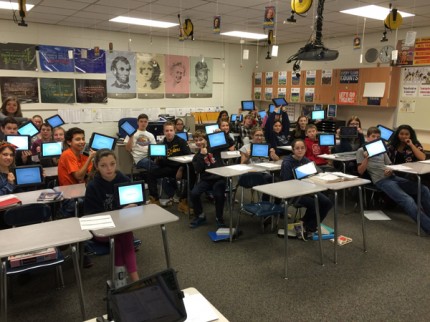
Courtesy photo. Students in one of Jason Morris’ eighth-grade history classes hold up their iPads to demonstrate the use of Nearpod, an interactive learning program.