
By Alan Scafuri
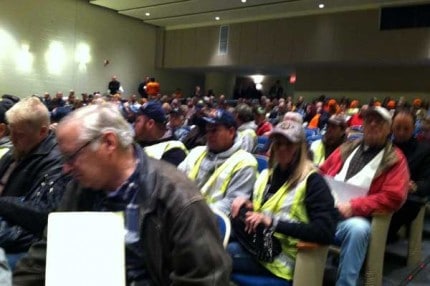
The George Prinzing Auditorium at the Washington Education Center was filled to capacity on Thursday, Nov. 20 as representatives from the Federal Energy Regulatory Commission (FERC) heard comments concerning the proposed ET Rover pipeline.
The project is projected to carry 3.25 billion cubic feet of natural gas per day from the Marcellus and Utica shale formations in Pennsylvania, Ohio, and West Virginia through Michigan on the way to Sarnia, Ontario, Canada.
According to information provided by FERC in its pre-filing review of the pipeline project, docket number PF14-14-000, “After receipt of formal FERC application, the FERC staff will take comments received on the project during the pre-filing stage and address them in a detailed environmental impact statement.”
ET Rover plans to file its formal application with FERC in January of 2015, and plans to begin construction on the pipeline in January, 2016. The proposed completion date for the pipeline is the end of 2017.
The first people to comment were mostly property owners across whose land the pipeline would traverse. These people are all adamantly opposed to this project.
Bryan Dever, a property owner who would be directly affected by this project, summed up the anti-pipeline sentiment, saying “This company, or at least their representatives, have lied to us, have been intimidating, all my neighbors have told me these terrible stories of feeling intimidated.” He went on to say that people are “scared to death.”
Dever then said that “We just want to be left alone. We just want our land. My children have seen the altercations I’ve had with these land agents, and they’re scared to get off the bus.”
The pro pipeline people then commented to FERC, led off by Bill Black, the Legal Director for Michigan Teamsters, who said that “Energy is the livelihood of Michigan’s economy, and the Rover pipeline will inject new life into that economy. The state’s labor organizations, the people who helped build this state, are ready to get to work on this important new project.”
Jason Geer, the Director of Energy and Environmental policy for the Michigan Chamber of Commerce, stated that “The Michigan Chamber of Commerce strongly supports the proposed Rover pipeline.”
According to ET Rover literature, the pipeline project is a $4.3 billion infrastructure investment. There will be $153 million in tax revenue paid annually to federal, state and local entities crossed by the pipeline, and more than $100 million in direct payments will be made to landowners for their property in the next two years.
Washtenaw County townships affected by the pipeline would receive over $2 million in ad valorem taxes while the pipeline is in service.
If anyone wishes to submit comments to FERC regarding this project, these comments are due by Dec. 18. See this story for detailed information on how to submit comments through the FERC website.